Three separate accounts, one shared purpose, and a surprisingly measurable effect on how much money actually stays in your pocket by year's end - that's the practical case for splitting your finances into distinct pots rather than letting everything sit in one undifferentiated balance. People who separate their money by function tend to spend less on impulse purchases and save more consistently, not because they earn more, but because they see their money more clearly.
A money pot is exactly what it sounds like: a dedicated, labeled portion of your finances set aside for a specific purpose. Some banking apps and financial platforms have turned this simple idea into a structured feature, letting users create multiple pots within a single account rather than juggling several separate accounts at different institutions. The appeal isn't cosmetic. When your rent money, your emergency fund, and your vacation savings live in visibly separate containers, you're far less likely to accidentally spend next month's bill money on something impulsive today. For readers curious about how these tools have evolved into more interactive formats, the money pot features available at online platforms show how the concept has expanded beyond pure banking into gamified savings and reward mechanics. That crossover matters because it demonstrates the same psychological principle at work: compartmentalization changes behavior.
This piece breaks down the three core types of money pots - savings, investment, and budgeting - and explains how each one contributes to a coherent wealth-building strategy. Rather than treating them as competing options, the smartest approach treats them as complementary tools, each solving a different financial problem.
A money pot is a designated portion of funds, physically or digitally separated from your general balance, earmarked for a specific financial goal or category of spending. The term originated in behavioral finance circles before being adopted by digital banking platforms, but the underlying principle predates any app: the "envelope system" that previous generations used to divide cash into labeled envelopes for rent, groceries, and savings worked on identical logic.
Mental accounting - the tendency to treat money differently depending on its designated purpose - is well documented in behavioral economics. When funds sit in a pot labeled "emergency fund," people are measurably less willing to dip into it for discretionary spending than they would be with an equivalent sum sitting in a general checking account. The label itself creates a psychological barrier.
Traditional multi-account banking required opening several accounts, often at different institutions, with separate login credentials and statements. Modern money pot systems solve this by letting users create sub-accounts within a single primary account, each with its own name, target, and sometimes its own interest rate or growth mechanism. This consolidation reduces friction without sacrificing the psychological benefit of separation.
Freelancers with irregular income, young professionals building their first financial habits, and families managing shared expenses tend to see the largest behavioral shift. Anyone whose income and outgoings don't follow a rigid monthly pattern benefits disproportionately, because pots impose structure where none previously existed.
Not all pots function identically, and the specific mechanics behind each one determine how useful it will be for a given goal. Understanding these mechanics prevents the common mistake of treating every pot as interchangeable.
Many platforms allow users to schedule recurring transfers into a pot - a fixed amount moved automatically on payday, for instance. This removes the decision-making burden each month and turns saving into a default behavior rather than a conscious choice that competes with the temptation to spend.
Some pots round up everyday purchases to the nearest whole currency unit and deposit the difference automatically. A coffee purchase costing 3.60 might round to 4.00, with the extra 0.40 routed straight into a savings pot. Individually trivial, these amounts accumulate meaningfully over months.
Visual progress bars, percentage completion indicators, and target dates give pots a game-like quality that plain savings accounts lack. Seeing a bar fill toward 100% creates a completion incentive that abstract numbers on a bank statement rarely produce.
Some platforms allow multiple users to contribute to a single pot - useful for shared expenses like a family holiday, a group gift, or joint household costs. Transparency around who contributed what removes a common source of friction in shared financial arrangements.
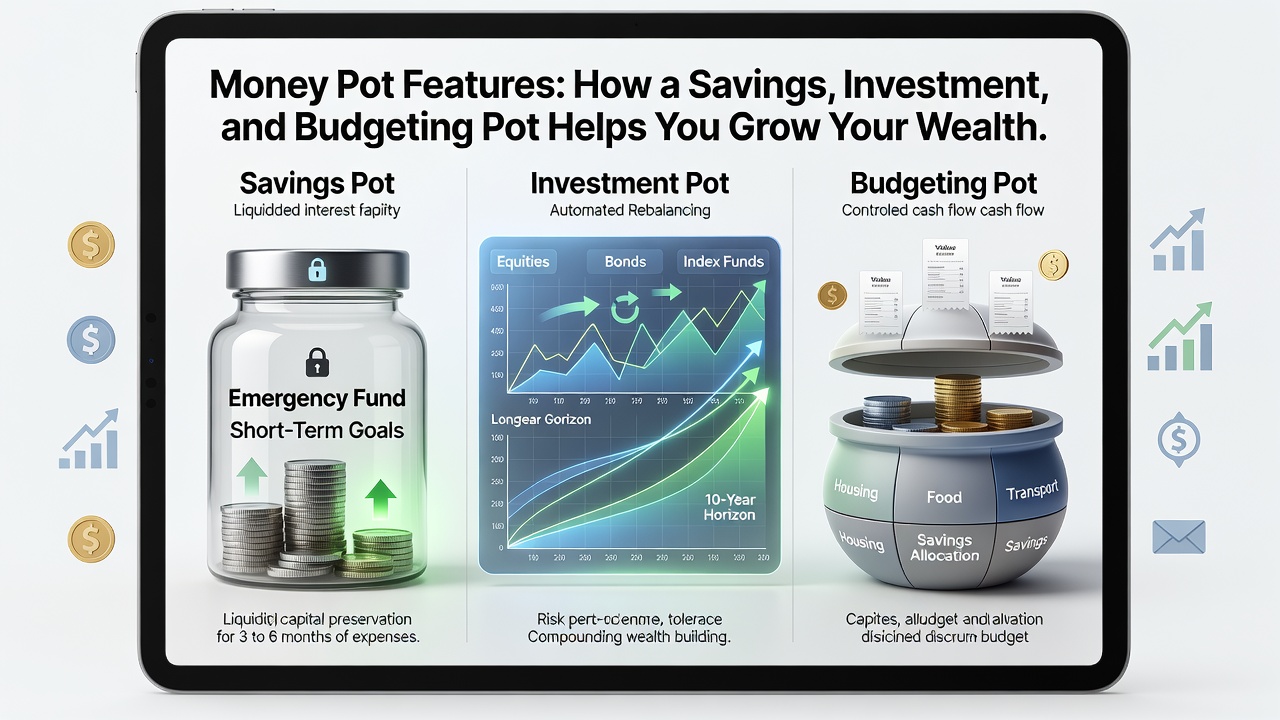
A savings pot is the most conservative and foundational of the three categories, designed to hold money that needs to remain accessible and secure rather than exposed to market fluctuation.
Financial advisors commonly recommend keeping three to six months of essential expenses in an easily accessible reserve. A dedicated savings pot labeled specifically for emergencies discourages casual withdrawal and keeps that reserve conceptually - and often functionally - separate from spending money.
Distinct from emergency reserves, short-term goal pots target specific purchases: a new laptop, a wedding, a home deposit. Because these goals have a defined endpoint and timeline, they benefit from the visual progress tracking many platforms offer.
Savings pots typically offer modest interest compared to investment vehicles, prioritizing liquidity and capital preservation over growth. That trade-off is intentional - the money needs to be there when you need it, not tied up or subject to loss.
Where a savings pot protects capital, an investment pot exposes it to growth opportunities, accepting a degree of risk in exchange for the potential of higher returns over a longer time horizon.
The suitability of an investment pot depends heavily on how long the money can remain untouched and how much volatility the account holder can tolerate without panic-selling. Money needed within the next year has no business sitting in an investment pot; money that won't be touched for a decade or more is a natural fit.
Many investment pots allow allocation across multiple asset classes - equities, bonds, index funds - within one structure, letting users diversify without managing several separate brokerage relationships. This built-in diversification reduces the concentration risk that comes from putting everything into a single asset.
Some platforms automatically rebalance an investment pot's holdings to maintain a target allocation as market values shift. Without rebalancing, a pot that started as 60% equities and 40% bonds can drift significantly over time as one asset class outperforms the other, quietly increasing risk exposure without the user noticing.
A budgeting pot addresses a different problem entirely: not growth or protection, but discipline over routine spending. It answers the question "how much can I safely spend this week without jeopardizing my other goals?"
Splitting a budget into pots for groceries, transportation, entertainment, and dining out gives immediate visibility into which categories are consistently over budget. This granularity is difficult to achieve when all spending draws from one undivided account balance.
Many budgeting pots include configurable alerts that notify users when a category approaches its limit. This early warning system allows course correction mid-month rather than discovering the overspend only when reviewing a statement weeks later.
For those with variable income, aligning budgeting pot allocations to each pay cycle rather than a fixed calendar month produces more accurate spending guardrails. A freelancer paid irregularly benefits from resetting pot allocations each time income arrives, rather than forcing irregular earnings into a rigid monthly template.
None of these three pot types functions best in isolation. The real wealth-building advantage comes from running them concurrently, each handling a distinct layer of your financial life.
A practical structure places immediate spending needs in a budgeting pot, a protective buffer in a savings pot, and long-term growth capital in an investment pot. Money flows logically between them: budgeting pots handle the present, savings pots handle the near future and emergencies, and investment pots handle the distant future.
The right balance between these three pots shifts as life circumstances evolve. Someone early in their career with minimal savings should weight allocation heavily toward the savings pot before increasing investment contributions; someone with an established emergency fund can shift new income more aggressively toward the investment pot.
Overfunding an investment pot before establishing an adequate emergency reserve leaves people vulnerable to forced asset sales during unexpected expenses, often at inopportune market moments. Conversely, keeping too much money in low-yield savings pots long after an adequate reserve has been built sacrifices growth unnecessarily.
Most modern banking platforms let you create multiple pots within a single account, each labeled and tracked separately without requiring new account numbers or separate applications. This consolidation gives you the psychological benefit of separation without the administrative burden of managing several institutions.
A common benchmark is three to six months of essential living expenses fully covered in a savings pot before directing meaningful contributions toward investments. This buffer prevents the need to liquidate investments prematurely during unexpected financial shocks.
Yes - aligning budgeting pot allocations to each income event rather than a fixed monthly schedule works better for freelancers and variable earners. Resetting category allocations each time money arrives keeps spending guardrails accurate even when income timing is unpredictable.
A savings pot prioritizes liquidity and capital preservation, typically earning modest interest with minimal risk of loss. An investment pot accepts market risk and volatility in exchange for higher potential long-term returns, making it suitable only for money you won't need in the near term.
Round-up mechanics generate relatively small amounts individually, but consistent daily spending can accumulate a meaningful sum over a year without requiring any conscious effort. They work best as a supplement to deliberate contributions rather than as your sole savings strategy.
A quarterly review is generally sufficient for most people, allowing enough time to see meaningful progress while still catching misallocations before they compound. Major life events - a new job, a move, a change in income - warrant an immediate review regardless of schedule.