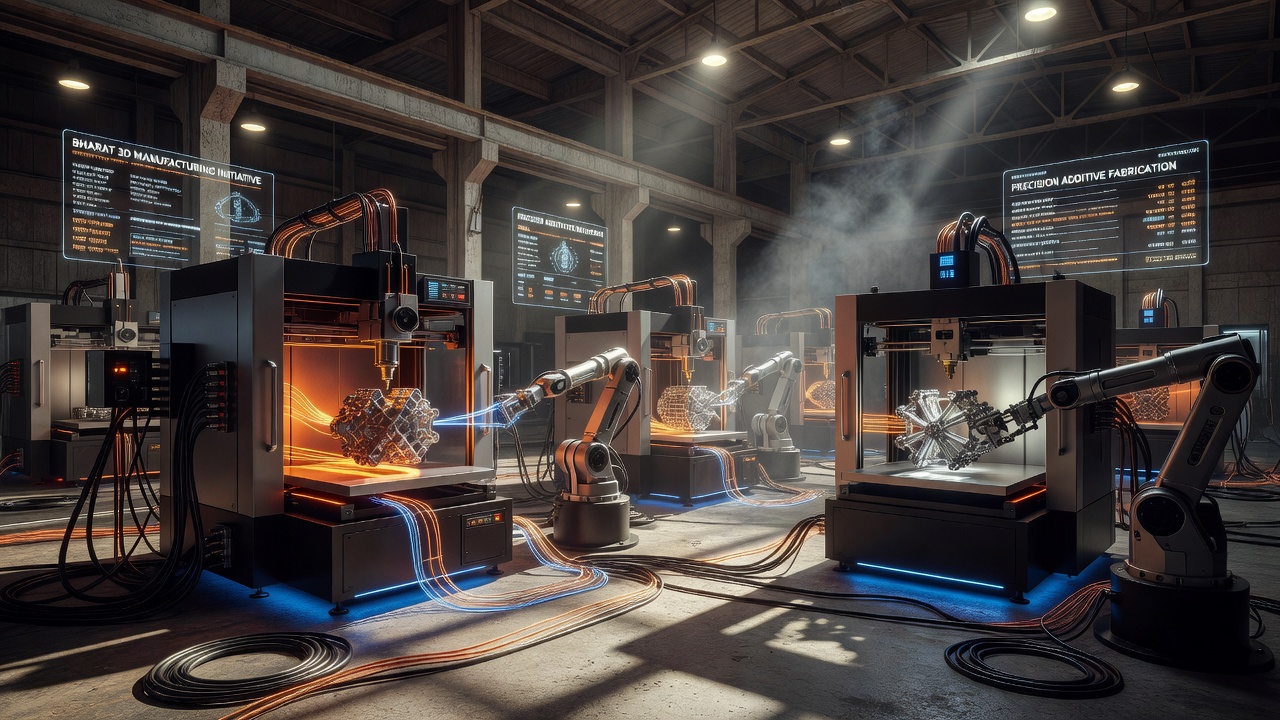
A government factsheet released Wednesday lays out how India is positioning itself as a serious contender in Additive Manufacturing (AM) - the 3D printing technology in which a digital file, rather than a human hand or a fixed mould, directs how an object takes physical shape. The shift sounds technical, but its implications are concrete: faster prototyping, lighter components, and manufacturing that no longer depends on large production runs to be economical.
The National Strategy for Additive Manufacturing (NSAM), launched in 2022, has been the backbone of this effort. So far it has trained over 1,54,000 individuals and supported 56 AM startups, building a workforce and entrepreneurial base that barely existed in the country a decade ago. That groundwork matters because AM is not just a factory-floor innovation; it increasingly touches sectors from aerospace to healthcare, much as everyday digital tools - whether it's understanding how to install a VPN on macOS or adopting new design software - have become part of ordinary technical literacy. The strategy is now entering its NSAM 2.0 phase, with ambitions for a market considerably larger than its first iteration, framed explicitly around the goals of Atmanirbhar Bharat and Viksit Bharat.
The numbers underpinning this push are substantial. The global AM machines market is projected to reach $149 billion by 2035, while the AM-electronics supply chain alone is expected to expand from $18 billion to $112 billion. These are not marginal gains - they represent a structural change in how components across polymers, metals, composites, ceramics and semiconductor-grade materials get produced. India's factsheet frames this as an opening: a chance to become a competitive manufacturer of AM platforms rather than merely a consumer of imported printing technology and parts.
That ambition will be on display later this month at ESTIC-2026, the second edition of India's Emerging Science, Technology and Innovation Conclave, organised by the Council of Scientific and Industrial Research (CSIR) from October 27 to 29. Spanning 12 thematic areas, the conclave will bring together plenary sessions, technical discussions and exhibitions covering AM alongside other emerging technologies, with an eye on strategic collaborations that feed into the Viksit Bharat 2047 vision.
The clearest evidence of AM's practical reach so far comes from India's space programme. In May 2024, IIT Madras-incubated startup Agnikul Cosmos launched Agnibaan-SOrTeD, powered by a single-piece, 3D-printed semi-cryogenic rocket engine. The mission showed that AM can produce engine geometries too complex for conventional casting or machining, compressing development timelines for indigenous space hardware. NSAM is now backing similar startups working on critical engine components.
The defence establishment has moved just as decisively. The Indian Army's first AM-printed two-storey dwelling unit went up in Ahmedabad in just 12 weeks, and the approach has since extended to precast defensive structures in demanding terrain such as Ladakh. NSAM is also helping all three armed services set up workshop-level AM facilities for maintenance, repair and overhaul work - a capability that could reduce dependence on slow, externally sourced spare parts in remote postings.
Perhaps the most personal application lies in medicine. The Technology Development Board is supporting 3D-printed bone grafts made from indigenous bioceramic materials, allowing implants to be tailored to an individual patient's anatomy rather than forcing a standard fit. Beyond the clinical benefit, this reduces reliance on imported medical devices and strengthens domestic manufacturing - a pattern now repeating across India's AM landscape, where a single technology is reshaping how the country builds everything from rockets to replacement bone.