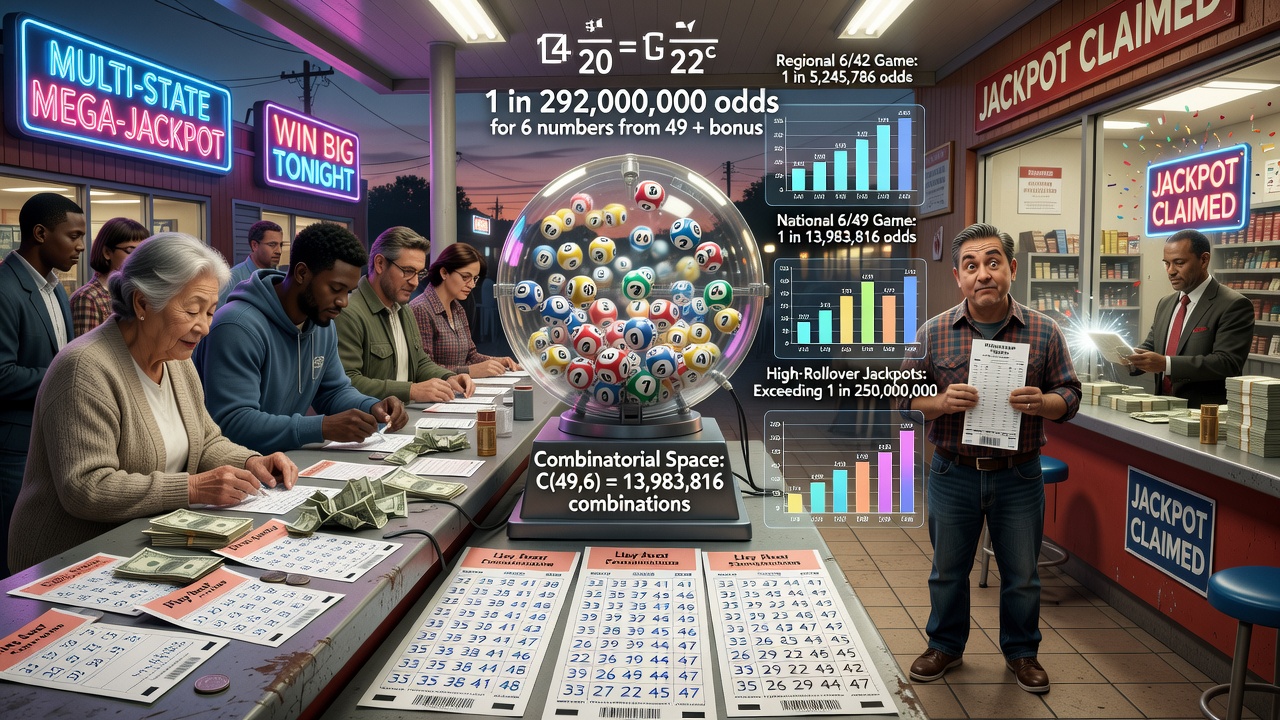
One in 292 million. That is the probability of matching all six numbers in a typical major lottery draw, a figure so remote that you are statistically more likely to be struck by lightning twice than to claim a top prize on a single ticket. Yet somebody wins almost every week. Jackpots roll over, then suddenly a single ticket, sometimes from a small-town gas station, splits or takes the entire pot. That contradiction - near-impossible odds paired with regular winners - is what keeps hundreds of millions of players buying tickets despite knowing the math is stacked against them.
The truth is that most players approach lottery play with vague hope rather than an actual plan, and that gap is exactly where meaningful improvement is possible. Understanding how to win a jackpot starts with accepting what you cannot change - the fixed odds set by the game's design - and focusing instead on what you can control: number selection habits, spending discipline, syndicate participation, and prize structure awareness. For a detailed breakdown of realistic tactics, the guide on how to win jackpot lays out the mechanics that separate casual players from those who play with intent. None of this guarantees a win, but it does change how efficiently you spend your money and how you handle a win if it happens.
This piece breaks down the real odds behind major lotteries, the strategies with genuine mathematical grounding, and the practical steps that can improve your position without promising fantasy outcomes. Expect clear numbers, honest limitations, and no false promises about beating a system built on randomness.
Lottery odds come from combinatorics, not luck-based estimation. A game requiring you to match 6 numbers from a pool of 49, for instance, generates nearly 14 million possible combinations. Add a bonus ball drawn from a separate pool, as many major lotteries do, and the odds stretch into the hundreds of millions. The math is fixed the moment the game is designed - organizers set the number pool size specifically to create a target odds ratio and a target jackpot growth rate. No amount of strategy alters the denominator in that fraction.
Each draw is an independent event. Whether a number was drawn last week or has not appeared in two years has zero bearing on this week's outcome. This is the single most misunderstood principle in lottery play. Players chase "cold" numbers believing they are "due," or avoid "hot" numbers assuming they are exhausted - both approaches misread how random draws function. Jackpot winning probability resets completely with every draw, unaffected by history.
Not all lotteries carry the same risk-reward ratio. Smaller regional games with fewer number combinations offer dramatically better odds, though with smaller jackpots. Multi-state or national games offer odds in the hundreds of millions but produce prizes large enough to change a life instantly. Players serious about lottery odds and winning tips should treat this as a genuine trade-off rather than defaulting to whichever jackpot headline is largest that week.
No selection method beats pure randomness in terms of probability - every combination has identical odds. Where strategy matters is in avoiding shared prizes. Numbers based on birthdays cluster between 1 and 31, meaning if you win with those numbers, you are statistically more likely to split the jackpot with other players who used the same logic. Choosing numbers above 31, or a mix that avoids common patterns like straight lines on a play slip, does not improve your odds of winning but does improve your odds of keeping the full prize if you do win.
Joining or forming a lottery syndicate is among the best strategies for lottery jackpot participation because it multiplies your combinations without multiplying your individual spend. A group of fifty people pooling money to buy fifty tickets covers fifty times the combinations one person could afford alone. The trade-off is obvious: any prize gets divided among the group. Still, for players focused on increasing their statistical exposure rather than chasing a solo fortune, syndicates offer a measurable, honest improvement in participation odds.
Choosing which lottery to play is itself a strategic decision. A game with smaller number pools and lower jackpots offers meaningfully better odds per ticket. Players who prioritize probability over prize size often do better long-term by concentrating on these smaller games rather than exclusively chasing nine-figure jackpots with near-impossible odds.
Buying more tickets does increase your chances of winning jackpot prizes, but only marginally relative to the increased spend, since the odds are so large that doubling your tickets from two to four barely moves your probability in absolute terms. The discipline that matters more is consistency paired with a strict budget - treating lottery play as entertainment spending, not investment, and never exceeding what you can lose without financial consequence.
Jackpots that have rolled over multiple times without a winner grow larger, which changes the expected value calculation even though it does not change your odds of winning. Playing during high-rollover periods means a higher potential payout for the same ticket price and same odds - a rational, if modest, edge for players tracking value rather than raw excitement.
Many players sabotage their own approach by chasing patterns, buying tickets impulsively after emotional triggers, or doubling spend after a near-miss. None of these behaviors improve odds; all of them increase net losses over time. Recognizing these patterns in your own play is as important as any number-selection method.
Every lottery has a claim window, often ranging from several months to a year, and specific documentation requirements. Winners typically must present the physical ticket, valid identification, and in many jurisdictions, complete tax paperwork before funds are released. Missing procedural steps has cost real winners real money, so understanding your specific lottery's claim process before you ever win is a practical, not paranoid, precaution.
Most major lotteries offer winners a choice between a reduced lump sum paid immediately or the full advertised jackpot paid in installments over two to three decades. The lump sum is smaller because it accounts for the time value of money, but it gives winners immediate control over investment decisions. The annuity offers steady, predictable income and some protection against poor financial decisions made in the emotional aftermath of a win.
Some jurisdictions allow winners to claim prizes anonymously or through a trust, which shields them from public exposure and the surge of requests that typically follows a public win. Consulting a financial advisor and an attorney before making any major decisions is standard practice among sudden-wealth recipients, and skipping this step has historically led to mismanaged windfalls.
Software, wheeling systems, and "hot number" trackers are sold with the implicit promise of beating the odds. None can, because each draw is mathematically independent and unaffected by past results. Understanding this prevents wasted money on systems that promise an edge randomness simply does not allow.
Strategy in lottery play does not create luck - it manages exposure, cost, and prize-sharing risk. Recognizing this distinction keeps expectations grounded and playing habits sustainable, rather than chasing a false sense of control over an inherently random event.
It improves your odds proportionally, but the baseline odds are so low that the practical difference is small. Ten tickets give you ten times the chances of one ticket, yet you're still working against odds in the millions or hundreds of millions, so budget discipline matters more than volume.
No. Every number and combination carries identical probability in a fair, randomized draw. Patterns in past results reflect coincidence, not any underlying bias in the numbers themselves.
Yes, if your goal is increasing overall odds of winning something rather than maximizing a potential solo payout. Syndicates spread cost and multiply combinations, though any prize is divided among all members proportionally.
This depends on your financial discipline and immediate needs. Lump sum offers control and a smaller total amount; annuity offers a larger cumulative payout spread over decades with built-in financial pacing. Consulting a financial advisor before deciding is strongly recommended.
Yes, in terms of pure probability. Regional games typically have far smaller number pools, meaning significantly better odds per ticket, even though the jackpots are smaller than national or multi-state games.
No verified evidence supports this claim. Lottery draws are random and independent, so no system based on historical patterns can predict or influence future outcomes.