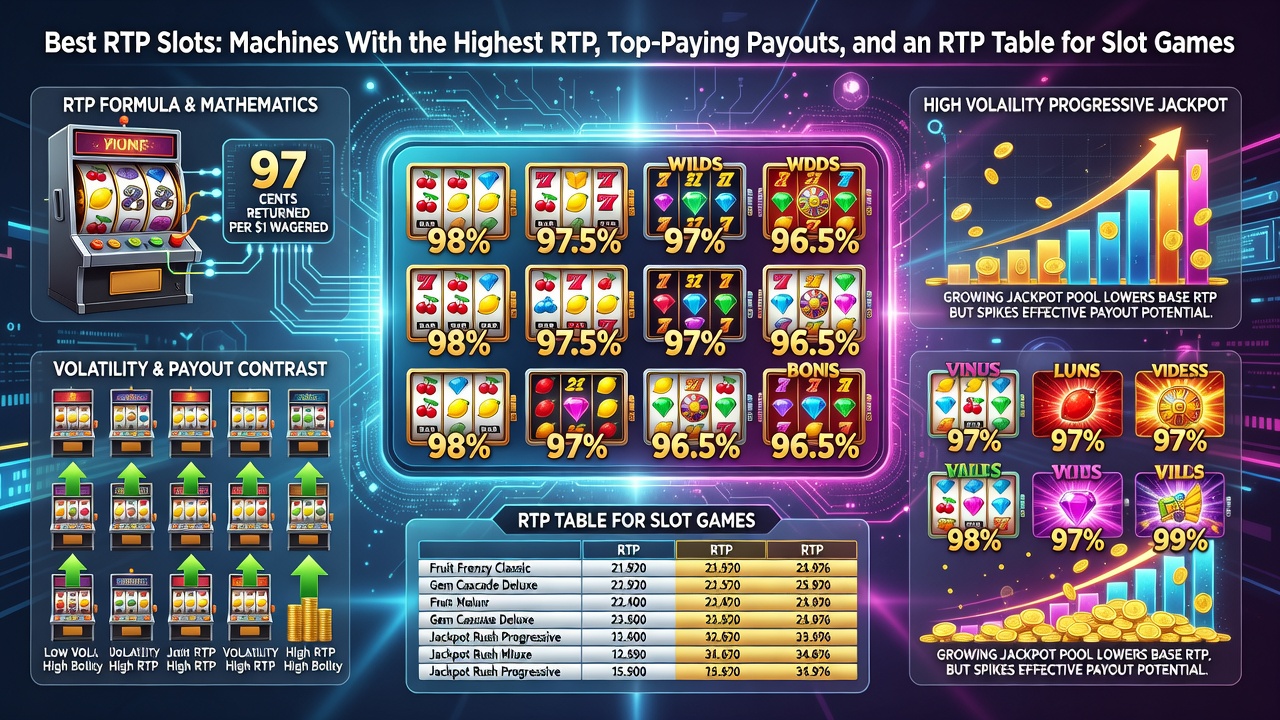
A slot machine set at 98% RTP returns, on average, two dollars less for every hundred wagered than a machine at 96%. That gap sounds small until you multiply it across thousands of spins in a single session. Over time, that difference decides whether a player walks away with something left in their balance or empties it twice as fast.
Casinos rarely advertise this number prominently, yet it sits quietly in the game information menu of nearly every online slot. Players who understand it gain a real edge in choosing where to spend their time and money. For those who want a shortcut to the research, there's a resource that explains exactly which slots have the best rtp and why the differences matter more than most players assume. The rest of this piece breaks down what RTP actually measures, which games consistently rank at the top, and how to read the numbers without falling for marketing gloss.
Return to Player is a theoretical average calculated over millions of simulated spins, not a promise about any single session. A slot advertising 97% RTP is programmed so that, across its full lifetime of play across all users, it pays back 97 cents of every dollar wagered. The remaining 3% forms the house's structural advantage, sometimes called the house edge. This figure is baked into the game's math model before it ever reaches a casino floor or a website, and it cannot be altered by the operator without regulatory approval.
RTP tells you how much a machine pays back over time, but it says nothing about how that money arrives. Volatility describes the size and frequency of wins. A high-RTP slot can still be brutally volatile, delivering long dry stretches punctuated by large payouts. Hit frequency, meanwhile, measures how often a spin returns any win at all, regardless of size. Confusing these three metrics leads players to make poor choices, such as assuming a 97% RTP slot will feel generous minute to minute when it's actually built for rare, oversized hits.
Ignoring RTP is like ignoring interest rates on a loan. It won't ruin a single session, but it shapes long-term outcomes. Players chasing entertainment value with minimal bankroll erosion should gravitate toward best RTP slots as a baseline filter, then layer in personal preferences for theme, volatility, and bonus mechanics afterward.
Certain long-standing games have built reputations around exceptionally high RTP figures, often exceeding 97.5%. These tend to be simpler in design, with fewer bonus features and more straightforward paytables, which allows developers to allocate a larger share of wagers back to players rather than funding elaborate animations or jackpot pools. Games in this category often appeal to players who prioritize steady value over flashy presentation.
Not every high-payback game is old or plain. Several contemporary video slots manage to combine rich graphics and layered bonus rounds while still maintaining RTP figures above 96.5%. Developers achieve this balance by adjusting hit frequency and volatility rather than cutting into the payback percentage itself.
Progressive slots complicate the picture. Their base RTP, excluding the jackpot contribution, often sits lower than standalone games because a portion of every wager feeds the growing jackpot pool. Once that jackpot potential is factored back in, the effective RTP can spike dramatically, but only for the rare player who actually hits it. This is why comparing progressive and non-progressive games side by side requires separating base RTP from jackpot-inclusive RTP.
Slots designed to mimic table game mechanics, such as those built around card or dice themes, sometimes carry RTP figures closer to blackjack or baccarat than to typical slot averages. These titles borrow the tighter mathematical models of table games while retaining the reel-based interface players recognize from traditional slots.
Branded slots, built around film franchises, television shows, or musical acts, often carry licensing costs that developers offset by trimming the RTP slightly compared to original in-house titles. This doesn't make branded slots bad choices, but players seeking slots with top RTP percentage should scrutinize licensed games more carefully rather than assuming brand recognition equals better value.
Volatility tiers don't correlate neatly with RTP. Some low-volatility games post modest RTP figures around 94%, while certain high-volatility slots reach 97% or higher despite their unpredictable payout rhythm. Sorting slots by both volatility and RTP together, rather than RTP alone, gives a fuller picture of what a session will actually feel like.
Reliable RTP figures come from the game's official information screen, the developer's technical documentation, or licensed casino databases that publish audited figures. Third-party blogs sometimes list outdated or incorrect numbers, so cross-referencing multiple sources before trusting a claimed RTP is a reasonable habit.
The same slot title can carry different RTP settings depending on the operator, since some developers offer configurable RTP ranges that casinos select from within regulatory limits. A game might run at 96% on one platform and 94.5% on another. This makes checking the specific RTP table for slot games on the casino you actually use more useful than relying on a generic figure quoted elsewhere.
A practical approach involves creating a simple reference list of preferred titles alongside their published RTP, volatility rating, and typical bet range. This turns an abstract percentage into a decision-making tool rather than trivia, letting players filter game libraries quickly instead of testing dozens of titles blindly.
Theoretical RTP describes millions of spins, not the fifty or hundred a typical player completes in one sitting. Short-term variance means a 97% RTP slot can easily hand back only 60% during a rough session, or 150% during a lucky one. Understanding this gap prevents players from mistaking a bad night for evidence that the published RTP was false.
Effective payout also shifts based on betting patterns. Some slots increase RTP slightly at maximum bet levels to encourage larger wagers, particularly when bonus features or jackpot eligibility are locked behind higher stakes. Reading the paytable's fine print reveals whether a game's true payback potential requires betting beyond the minimum.
Fruit-themed classic slots and simplified multi-line video slots repeatedly appear among the highest RTP slot machines across multiple studios, largely because their reduced feature complexity leaves more design room for generous payback math. Players asking which slots pay out the most should treat these categories as a reliable starting point rather than an absolute rule, since individual titles still vary.
A player with a limited bankroll and low risk tolerance benefits more from pairing high RTP with low or medium volatility, smoothing out the ride even if peak wins are smaller. A player chasing rare, large payouts might accept lower RTP if it comes bundled with high volatility and jackpot potential.
RTP helps estimate how long a given bankroll should last under average conditions, but it should never be treated as a guarantee. Dividing a bankroll by expected bet size and factoring in the house edge gives a rough session length estimate, useful for pacing play rather than predicting exact outcomes.
Common errors include comparing a game's demo-mode RTP to its real-money version, ignoring regional RTP variations, and assuming a high advertised RTP applies equally to every bet level or bonus feature within the same title. Careful reading of each game's specific terms avoids these traps.
Anything above 96% is generally considered strong, while figures above 97.5% place a game among the most generous available. Below 94% is common in many physical casino slots but weaker for online play, where higher-RTP alternatives are usually accessible.
No, RTP measures long-term payback percentage, not how often a spin results in a win. A high-RTP slot can still have low hit frequency if it's designed with high volatility, meaning wins are rarer but larger when they occur.
The core RTP is fixed within the game's programming and doesn't drift during play, but some developers release multiple configurable versions of the same title with different RTP settings for different markets or operators. Always check the specific version listed on the platform being used.
This depends on the specific game's paytable, since some titles boost effective RTP at higher bet levels by unlocking additional features or jackpot eligibility. Reviewing the paytable and rules screen clarifies whether bet size meaningfully affects payback in a given title.
Some developers build configurable RTP ranges into a game's code, allowing individual casinos to select a specific setting within regulatory limits. This means checking the RTP listed on the exact platform being played is more reliable than trusting a generic figure found elsewhere.
Yes, a portion of every wager on a progressive slot feeds the growing jackpot pool, which usually lowers the base RTP compared to non-progressive versions of similar games. The trade-off is a much larger potential payout for the small percentage of players who eventually hit the jackpot.